
✍️ Service page by Md. Salauddin Biswas
Healthcare, Medical & Public Health Content SEO Specialist | MA in Medical Anthropology, University of Heidelberg, Germany | Former Senior Research Associate, James P Grant School of Public Health, BRAC University | Director & Head of Content, SA WEBSOFT.
Targeted Hospital SEO
Help Patients Find the Right Hospital Service Faster
Many hospital websites have many pages, departments, doctors, services, and locations. But patients can still feel lost when they do not know which page, doctor, or booking path fits their need.
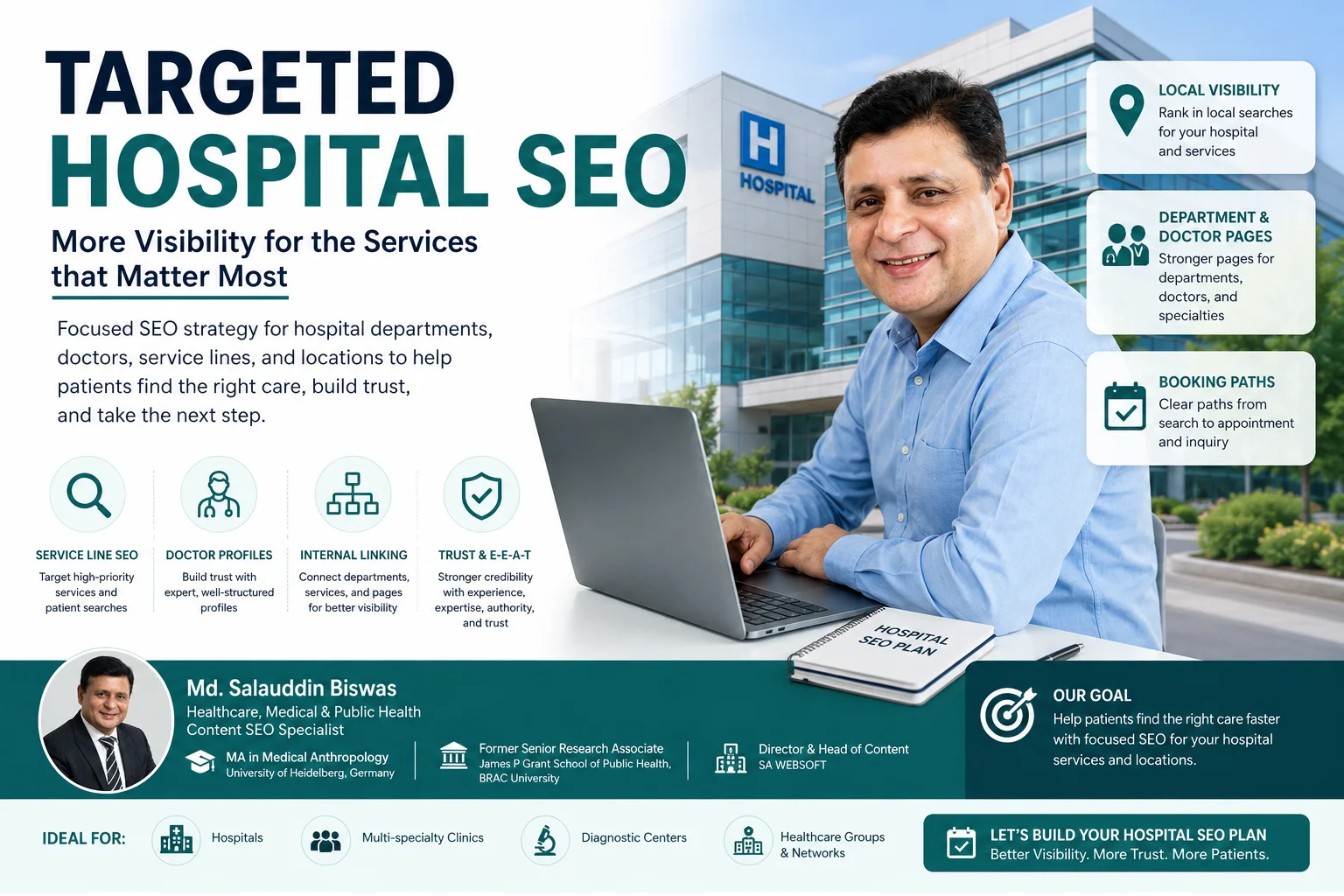
Targeted Hospital SEO helps your hospital or multi-specialty clinic focus on the departments, service lines, locations, and patient searches that matter most.
You get a clear plan for department pages, doctor profiles, service pages, local visibility, internal links, E-E-A-T signals, and booking paths.
Simple goal: help patients move from search to the right hospital service with less confusion and more trust.
Quick Answer
- Targeted Hospital SEO is a focused SEO plan for hospital departments, doctors, service lines, and locations.
- It helps patients find the right service page, understand the care path, connect services with doctors, trust the hospital, and take the next step.
- It is useful for hospitals, multi-specialty clinics, diagnostic centers, and healthcare groups with many pages, services, or locations.
Why Hospital SEO Needs a Clear Focus
A hospital website is usually larger than a clinic website.
It may have departments, doctors, tests, treatments, health packages, branches, and appointment pages.
But more pages do not always mean better SEO.
Hospital SEO works best when each priority service has a clear search purpose, patient journey, internal link path, and booking direction.
Example: A patient may search “cardiology hospital near me,” “MRI scan cost,” “best orthopedic doctor for knee pain,” or “emergency care near me.” Each search needs a different page path.
Common Hospital SEO Problems That Confuse Patients
These problems can hide inside large healthcare websites. They may affect patient trust, search visibility, and appointment flow.
Department pages are thin
Pages list services but do not explain symptoms, conditions, doctors, tests, treatments, or next steps.
Doctors are not connected
Doctor profiles are separate from service pages, so patients cannot connect expertise with the care they need.
Service lines compete
Many pages target similar terms. This can confuse search engines and weaken important pages.
Local intent is weak
The website does not clearly support city, branch, neighborhood, or “near me” hospital searches.
Booking paths are unclear
Patients read a page but do not know how to book, which doctor to choose, or which department to contact.
Trust signals are missing
Pages do not show enough credentials, review process, author notes, references, or clear medical responsibility.
What Targeted Hospital SEO Includes
The goal is to focus on the hospital pages that can help patients and support business growth.
- Department SEO map — which departments need stronger pages and internal links.
- Service-line keyword plan — search terms for high-priority hospital services.
- Doctor profile structure — how doctor pages should support trust and service visibility.
- Condition and treatment clusters — pages that connect patient problems to care options.
- Local SEO direction — location, branch, city, and “near me” search planning.
- Internal linking plan — how departments, doctors, services, and booking pages connect.
- Booking path review — how patients move from search to appointment or inquiry.
How Hospital Searches Become Clear Page Paths
Hospital SEO should guide patients through connected pages. One page should not work alone.
Search path
Symptom → Department → Doctor
A patient starts with a symptom, learns which department treats it, then chooses a doctor or appointment option.
Search path
Condition → Treatment → Booking
A patient learns about a condition, understands available treatments, then moves to a consultation page.
Search path
Location → Service → Appointment
A local patient finds a nearby branch, checks the service, then contacts the right department.
Who this service is for
This service is for healthcare organizations that need focused SEO for departments, locations, and high-priority services.
Hospitals
For hospitals that need stronger department pages, doctor profiles, and service-line visibility.
Multi-specialty clinics
For clinics with several departments that need better page structure and local SEO.
Diagnostic centers
For centers that need clearer pages for tests, imaging, packages, and local patient searches.
Healthcare groups
For organizations with multiple branches, departments, doctors, or service locations.
Hospital Services I Can Help Plan
The strategy can be adapted for different hospital services and specialties.
- Cardiology
- Orthopedics
- ENT
- Dermatology
- Gynecology
- Pediatrics
- Gastroenterology
- Colorectal surgery
- Diagnostics
- Imaging and scans
- Emergency care
- Mental health services
My Targeted Hospital SEO Process
The process starts with focus. We decide which hospital services matter most before building the plan.
Step 1
Choose priority services
We identify the departments, services, doctors, and locations that need SEO focus first.
Step 2
Map patient searches
I organize search intent by symptoms, conditions, treatments, doctors, tests, and locations.
Step 3
Build page systems
I plan how department, doctor, service, location, and booking pages should connect.
Step 4
Create the roadmap
You receive a clear plan for page improvements, content creation, internal links, and tracking.
What you receive
You receive a focused hospital SEO plan that can guide your content, website, and marketing team.
- Priority department map — which departments need SEO attention first.
- Service-line keyword plan — search terms mapped to hospital services.
- Doctor profile recommendations — how profiles should support trust and search.
- Page structure recommendations — what each important page should include.
- Internal linking plan — how departments, services, doctors, and booking pages should connect.
- Local SEO notes — location and branch visibility planning.
- Tracking direction — what to monitor in Search Console, Analytics, calls, forms, and booking actions.
Why Hospital SEO Is Different From Clinic SEO
Hospital SEO is not just ranking a few pages.
A hospital website must organize many services, many doctors, and many patient needs.
It must also communicate trust, medical responsibility, and next steps clearly.
My hospital SEO philosophy
A hospital website should help patients find the right care faster. SEO should support that care journey, not make the website harder to understand.
Why work with me
I have worked with SEO, content writing, and E-E-A-T-focused content since 2017. Now I focus only on medical and health-related websites.
My background includes Medical Anthropology from the University of Heidelberg, Germany, and public health research experience at the James P Grant School of Public Health, BRAC University.
This helps me plan hospital SEO with patient understanding, service structure, health communication, and search visibility in mind.
My focus: hospital SEO that connects departments, doctors, service pages, local visibility, patient questions, and booking paths.
Related services
Medical Website Structure Audit
Find structure gaps before improving hospital pages.
Healthcare Content Strategy
Build patient-first content for services, departments, and FAQs.
Patient Booking Page Design
Improve the page where hospital visitors decide to book.
Frequently Asked Questions
Short answers for hospital teams planning targeted SEO.
What is Targeted Hospital SEO?
Targeted Hospital SEO is a focused strategy for improving visibility of important hospital departments, service pages, doctors, locations, and patient booking paths.
How is hospital SEO different from clinic SEO?
Hospital SEO usually involves more departments, more doctors, more services, more locations, and more complex patient journeys. It needs a stronger page structure and internal linking plan.
Can this help individual departments?
Yes. The plan can focus on one department first, such as cardiology, ENT, orthopedics, diagnostics, women’s health, mental health, or surgery.
Do hospital doctor profiles matter for SEO?
Yes. Doctor profiles can support trust, expertise, service relevance, and patient decision-making when they are connected to the right department and service pages.
Can this support local hospital SEO?
Yes. The strategy can include branch pages, location signals, city or neighborhood targeting, and “near me” search planning.
Do you guarantee hospital SEO rankings?
No. I do not promise rankings. The goal is to create a stronger SEO foundation with clearer structure, better content, stronger trust signals, and more useful patient journeys.
Want stronger visibility for priority hospital services?
Get a focused hospital SEO plan for departments, doctors, service pages, locations, internal links, and booking paths.
About Md. Salauddin Biswas
Md. Salauddin Biswas is a healthcare, medical, and public health content SEO specialist. He has worked with SEO, E-E-A-T-focused content, and healthcare content since 2017. He is currently Director & Head of Content at SA WEBSOFT.
His background includes an MA in Medical Anthropology from the University of Heidelberg, Germany, and public health research experience at James P Grant School of Public Health, BRAC University.
This mix of SEO, research, and health communication helps him plan hospital SEO around patient needs, service structure, trust, and long-term search visibility.
If you want to see my previous works, please click Here.
Important note
This service supports hospital SEO planning, content structure, patient communication, and service-line visibility. It does not replace legal, clinical, or HIPAA compliance review. Medical claims, patient data handling, privacy language, and clinical information should be reviewed by the proper healthcare, legal, or compliance team before publishing.