What Healthcare SEO Includes and When Your Practice Needs It
Written by Salauddin Biswas
Independent healthcare website and SEO consultant
MA in Medical Anthropology, Heidelberg University, Germany
Former Senior Research Associate, James P Grant School of Public Health, BRAC University
Salauddin helps doctors, surgeons and private practices plan websites around how patients search, worry and decide. More about Salauddin
Editorial note: This article explains general SEO planning for health websites. It is not legal, medical or compliance advice. Privacy and advertising rules differ by country. SEO results vary and are never guaranteed. Last updated: November 2026.
Right now, someone near you is searching for help.
One person types “why does my knee hurt when I climb stairs.” Another searches “blood in stool” late at night, too embarrassed to say it aloud. A worried daughter looks up a diagnosis her mother just received. Patients rarely search in medical terms. They type what they feel, what they fear, or what they can barely explain.
Google shows them a list of providers. They click one. They book.
If that practice is not yours, you lose more than one appointment. You lose a patient who needed you, and the trust they would have passed on. Your care was not weaker. They simply never found you.
That is the real cost of weak search visibility: not lost rankings, but lost patients.
In this guide, you’ll learn what healthcare SEO includes, how it differs from regular SEO, when your practice needs it, and how to choose the right specialist.
Quick answer: Healthcare SEO helps doctors and practices get found by patients in Google search. It covers local SEO, technical SEO, on-page SEO, authority building, content strategy and audits. In healthcare, the work must also meet a higher bar for accuracy, trust and patient privacy.
What Is Healthcare SEO?
Healthcare SEO helps patients find your practice online. It is not one tactic. It is a system where several parts work toward one goal: more of the right patients finding you.
One thing sets this work apart. Health content can affect people’s lives. Google says its systems give even more weight to strong experience, expertise, authoritativeness and trust (E-E-A-T) on topics like health. Strong healthcare SEO respects that from day one.
The work covers four connected areas:
- Your website — so Google can read it and trust it
- Your local presence — so nearby patients find you fast
- Your content — so you answer what patients actually ask
- Your authority — so Google sees you as credible
Each part supports the others. Done right, search visibility turns into real patient calls.
Who needs it?
Healthcare SEO fits any practice that grows through new patients. The scale shifts. The need does not.
- Solo doctors and single-location practices — to win local “near me” searches
- Specialty practices — to rank for the conditions and procedures they treat
- Multi-location groups — to show up in every area they serve
A solo doctor and a large group chase different goals. But both lose patients when they stay invisible.
In short: Healthcare SEO is a connected system across your site, local presence, content and authority, built for any practice that depends on patients finding it.
Why Healthcare SEO Is Different From Regular SEO
Healthcare SEO carries higher stakes. A weak restaurant page leads to a mediocre dinner. A weak healthcare page can confuse a frightened patient, delay care, or damage trust at the exact moment someone decides whether to believe you.
That difference changes the whole approach. Your pages must do more than target keywords. They must help patients understand their options, prove your practice is real, and show that your information is careful and honest.
That is why generic SEO often fails for health websites. It chases traffic first. Healthcare SEO has to earn trust first.
The YMYL standard
Health content falls under what Google calls “Your Money or Your Life” (YMYL) topics. These are topics that can affect a person’s health, finances, safety or wellbeing.
For healthcare sites, this raises the bar. A patient may read your page before choosing a doctor, booking a test, or asking for treatment. So the page must be clear, accurate and trustworthy.
In practice, strong E-E-A-T on a health site means:
- Content written or reviewed by qualified people
- Medical and SEO claims backed by credible sources
- Clear author and reviewer information
- Accurate service, location and contact details
- A site that looks and behaves like a real healthcare provider
- No exaggerated promises about rankings or results
Regular SEO often skips these signals. In healthcare, they decide whether patients and search engines trust you.
Privacy and accuracy
Healthcare marketing also faces rules other industries rarely touch. Patient privacy, review requests, contact forms and tracking tools all need extra care. The rules differ in the US, UK and Australia.
Good healthcare SEO works inside those limits. It avoids exposing patient information, and it never uses patient stories or treatment details without proper permission. Your legal or compliance adviser makes the final decisions.
Accuracy here is more than a writing standard. Wrong hours, outdated services, or a broken contact path hurt both rankings and patient confidence. In the worst case, they send a real patient to the wrong place at the wrong time.
In short: Healthcare SEO answers to a higher bar for trust, accuracy and privacy. The tools look familiar. The stakes are far higher.
What Healthcare SEO Includes
Healthcare SEO combines several parts. But before any single part works, you have to understand what your patients feel when they search. That foundation shapes everything else.
Start with patient intent
Every health search carries a feeling. A patient does not just want information. They want relief from a worry. Strong healthcare SEO reads that feeling first.
And intent is not the same everywhere. It shifts by specialty, by condition, even by the words a patient is afraid to type. Miss that, and even flawless technical SEO falls flat. A few examples:
- Colorectal care — patients carry stigma and delay. They search quietly, often at night, in soft or indirect words. See how a colorectal surgeon’s website starts from the symptoms patients search for.
- Orthopedics — fear drives the search: fear of surgery, pain and lost mobility. Patients want honest reassurance about moving again.
- Hematology — the terms are unfamiliar and frightening. Patients often worry about the diagnosis and the cost at the same time.
When you know the real emotion, you can plan your website structure around it. You match patients’ words, ease their fear, and build trust before they ever call. That principle guides every part that follows.
Local SEO
A worried patient wants care close by, and fast. That makes local search your front door.
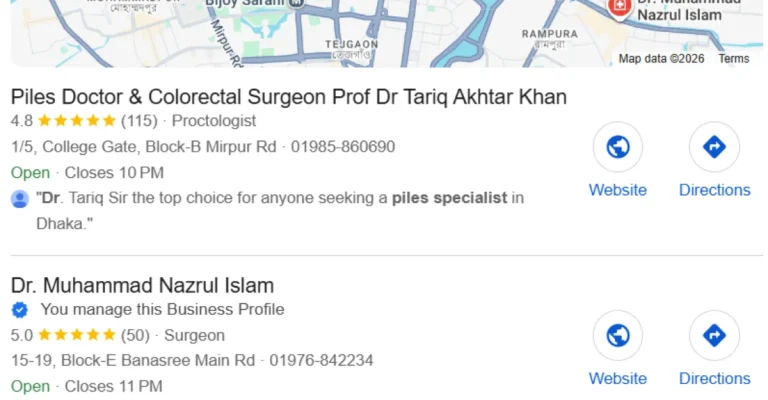
Patients choose based on distance, reviews and trust tied to their health. Your Google Business Profile, your place on the map and your reviews all shape that choice. Local SEO improves your profile, fixes your listings, and strengthens the signals behind local results. See Local SEO for Healthcare for the full picture.
Technical SEO
A patient in pain will not wait for a slow page. They leave.
Health sites often carry many service pages, location pages and provider profiles. Small technical errors can bury your most important pages. Technical SEO fixes crawl issues, speeds up pages, orders your structure, and adds structured data. See Technical SEO for Healthcare Websites for the details.
On-page SEO
On-page SEO sharpens the pages that meet patient demand: service pages, condition pages and provider profiles.
It matches each page to how patients search, structures the content clearly, and builds the relevance Google needs. Thin, vague pages usually lose to clear, intent-matched ones. Each main service and condition you treat deserves its own strong page.
Authority building
Authority comes from outside your site: mentions, links and reputation.
In healthcare, quality matters far more than volume. A mention from a respected medical directory, a health publication or a local hospital carries real weight. A random bought link does not, and it can break Google’s rules. Real authority is slow to build and hard to fake, which is exactly why it counts.
Content strategy
Content strategy ties the whole system together. It maps what patients search for, plans the pages that answer them, and keeps your pages from competing with each other. See Healthcare Content Strategy for how I plan it.
In short: Healthcare SEO runs on five parts — local, technical, on-page, authority and content — all built on a clear read of patient intent.
When Does Your Practice Need Healthcare SEO?
You need healthcare SEO when patients cannot find you where they search. Most practices feel the pain before they see the cause.
Signs you are losing patients
Each of these patterns points to weak search visibility:
- You do not appear on the map for “near me” searches in your area
- Smaller competitors keep ranking above you
- Your site gets little search traffic; most patients arrive by word of mouth
- New patient numbers have flattened or dropped, even with steady demand
- Your service pages are thin, generic, or missing
Two or more of these? Patients may be choosing practices that simply show up first. That is a visibility problem, not a care problem.
How to check where you stand
Start with an audit. It shows where your site falls short and what holds you back, so you know what to fix and in what order. Run one before you invest in anything else. See the Website & SEO Audit for how I do it.
What to Expect From SEO Work
SEO work follows a clear path. You will not see results overnight, and anyone who promises instant rankings is misleading you. What you should expect is steady, measurable progress.
The typical phases
Most SEO work moves through four stages:
- Assessment — an audit of your site, listings, content and competitors
- Strategy — a clear plan built around your services, area and goals
- Doing the work — technical fixes, content, local updates and authority building
- Measurement — tracking search visibility, traffic, calls and enquiries
Each phase feeds the next. Search competition never stops, so the work does not either.
How long it takes
SEO is slow. Google has said SEO work usually takes four months to a year to show its effect. Early movement often comes from local fixes and specific, less competitive searches.
Timelines depend on your competition, your starting point and your area. No honest provider guarantees exact rankings or patient numbers.
How Much Does Healthcare SEO Cost?
Cost depends on your scope, your area, and how many locations and services you target. A solo practice in a small town needs far less than a multi-location group competing across regions.
There is no single price because there is no single scope. You can see my prices on my Services page.
How to Choose a Healthcare SEO Specialist
Not every SEO provider is built for healthcare. A generic agency may understand keywords but miss the trust, privacy and patient-language demands that decide success here.
Look for someone who understands:
- How patients actually search — in symptoms, fears and plain words, not clinical terms
- Why health content is held to a higher bar for trust
- Local and technical SEO for health sites with many pages
- Patient privacy, and when to hand a question to your adviser
- Content accuracy, honest claims and careful sourcing
Why patient-language insight changes the work
A generic writer starts with a keyword list. Better healthcare SEO starts with the patient journey behind that list.
The phrase “knee pain doctor” is not just a search term. Behind it may sit fear of surgery or worry about missing work. “Blood in stool” is not just a topic. Behind it may sit embarrassment, silence and dread of a serious diagnosis.
When your specialist reads that layer, the pages change. They use the words patients use, answer the questions patients are afraid to ask, and guide someone from symptom to service to appointment without feeling cold or salesy.
My training in medical anthropology and my public health research shaped this lens. I learned how people describe illness, delay care, and let culture, stigma and fear shape their decisions. That is the difference between building pages around guesswork and building them around real patient behavior.
In short: Choose a specialist who reads patient intent, respects trust and privacy limits, and turns clinical expertise into a search experience patients can trust.
Frequently Asked Questions
What does healthcare SEO include?
It combines five connected parts: local SEO, technical SEO, on-page SEO, authority building and content strategy, all built on a clear read of patient intent. The exact mix depends on your size, area and goals.
How is healthcare SEO different from regular SEO?
Health content is a “Your Money or Your Life” topic. Google gives even more weight to strong signs of experience, expertise and trust on these topics. The work also has to protect patient privacy. The tools look similar. The stakes are far higher.
How long does healthcare SEO take to work?
Google has said SEO usually takes four months to a year to show its effect. Local fixes can help sooner. Your timeline depends on your starting point and your competition.
How much does healthcare SEO cost?
It depends on your scope, area, and number of locations and services. You can see my prices on my Services page.
Do small practices need SEO?
Often, yes. A solo practice leans heavily on local patients, and local search is exactly where those patients decide. The scope is smaller. The need is just as real.
How do I choose a healthcare SEO specialist?
Look for someone who understands patient search behavior, trust standards for health content, local and technical SEO, patient privacy and content accuracy. The section above walks through what to check.
Start With a Clear Picture of Where You Stand
Patients are searching for your care right now. The question is whether they find you or someone else.
The best first step is simple: a clear look at where you stand today, and where your biggest opportunity sits. Book a free 15-minute call, and I’ll tell you honestly where to start. If you already know you want a plan, see Healthcare SEO Consulting.
References
- Google Search Central — Creating helpful, reliable, people-first content
- Google Search Central — SEO Starter Guide
- Google Search Quality Rater Guidelines (official PDF) — YMYL and E-E-A-T
- Search Engine Roundtable — Google: Give SEOs 4-12 Months To See Positive Ranking Benefits
- U.S. Department of Health & Human Services — HIPAA for Professionals