
Technical SEO for Healthcare Websites | Complete Guide
How healthcare websites establish the underlying infrastructure that enables patients to find, trust, and select your services
Quick answer: Technical SEO on healthcare websites—covering page speed, mobile performance, schema markup, site structure, and crawlability—allows search engines and AI tools to find, understand, and rank medical content. Since Google imposes higher trust standards on medical information, medical content that has been thoroughly reviewed by experts may still fail to be seen by patients if there is no strong technical foundation.
Disclaimer: The article below provides general educational information on technical SEO for healthcare websites and must not be considered as medical, legal, or clinical advice. The outcomes of SEO activities will vary according to the state of the website, the degree of competition, and the quality of the implementation. You should always obtain advice from a qualified professional in respect of your specific situation.
When a high-quality healthcare website remains invisible in search results
Imagine a surgeon who has over 20 years’ experience and has carried out more than 300,000 patient consultations.
Now picture this surgeon putting out dozens of clear and compassionate condition pages in two languages, with them checked over by a specialist, including medical disclaimers and referring to reputable sources such as the NHS and NIDDK.
Dr. Muhammad Nazrul Islam, who is a colorectal and general surgeon based in Dhaka, runs the website nazrulislamcolorectal.com, offering information about conditions including piles, anal fissures, fistulas and hernias. On each page information is given regarding the symptoms, when it is necessary to see a doctor and when urgent care should be sought.
The clinical quality is high, the authorship is clear, and the qualifications are real.
Just because one has clinical experience does not ensure that search visibility will result.
Even if the content has been very carefully prepared, it will still remain mostly unseen if the website loads slowly on mobile devices, does not include structured data which identifies the page as being medical in nature and names both the author and the reviewer, or if its architecture makes it difficult for crawlers to access the various condition pages.
Imagine a patient typing into the search engine the query ‘why am I bleeding but it doesn’t hurt?’ after hours. In that case, if the appropriate page does not load or show up in the search results then it may as well not exist.
Orthopedic practices, for example tanvirorthopedics.com, the website of Dr. Tanvir Hasan Siddique who is a specialist in joint replacements in Dhaka, are also exposed to the same risks. The site is set out around patient-related concerns such as knee pain, hip pain, problems with mobility, and procedures including hip and knee replacement. Although this arrangement is logical, the fact that it is well organized does not ensure that crawling will be efficient or that AI systems will be able to extract citable answers.
It is here that technical SEO becomes important since it doesn’t take the place of content, trust, or local visibility but rather forms the basis upon which these elements depend.
When you have finished reading this page, you will know what technical SEO means in the healthcare sector, why it is particularly important in that area, and how the five main pillars are connected.
What is technical SEO like for healthcare websites?
Technical SEO includes all the non-content aspects of a website that influence whether search engines and, more and more, generative AI systems are able to discover, crawl, interpret, and rank medical content.
It covers load speed, mobile usability, structured data (schema markup), site architecture, internal links, and crawl efficiency.
Content SEO attends to language, tone, and medical accuracy, whereas technical SEO works behind the scenes.
Technical SEO is responsible for making sure that Google can access the page on the subject of an anal fissure, identify Dr. Islam as a qualified author, and prevent mobile users from leaving the site because of slow loading.
To sum up, content SEO makes your information valuable, while technical SEO makes sure it is discoverable.
Why healthcare sites face unique technical challenges
Healthcare websites are different from ordinary business websites for a number of reasons.
- YMYL trust standards. Google regards medical information as “Your Money or Your Life” content and therefore enforces more rigorous standards with regard to accuracy, authority, and reliability. Technical signals, for example those indicating a clear author and a medical reviewer, support this evaluation. This is a big part of why generic SEO fails for health websites and why medical sites need a stricter approach.
- Many condition pages with heavy assets. The site nazrulislamcolorectal.com has numerous pages, usually available in more than one language, and each of these pages includes images, videos, and references. The more pages there are, the greater the risk of the pages loading slowly or being missed by the indexation process.
- Provider and location complexity. Many practices have multiple sites which operate on different hours. In order to deal with this complexity it is necessary to use accurately structured data so that Google can correctly link the doctor, their specialty, and the location — a challenge that becomes even bigger with multi-location healthcare SEO.
- Medical schema needs. The types of schema such as Physician, MedicalCondition, and MedicalWebPage are essential since they tell search engines that a page concerning “painless rectal bleeding” is one about a medical condition and not a general blog post.
- Mobile-first pressure. Patients usually don’t look up information about their symptoms on desktop computers, instead carrying out searches like ‘anal pain during stool’ on mobile phones, typically while under stress. It’s important that mobile devices are both fast and easy to use.
- Crawl inefficiency. Websites having a large number of pages that are similar in condition and a poor internal structure waste Google’s crawl budget, and as a result valuable pages remain undiscovered.
- Platform and privacy concerns. WordPress plugins, custom themes, and the way hosting is configured can lead to technical complexity and raise privacy issues that need to be carefully managed.
To sum up, healthcare websites have a greater number of pages, are subject to more criticism with regard to trust, and have a more complicated structure. Technical errors affect these websites more than they affect most other types of websites.
Why technical SEO matters for healthcare
Technical gaps are not just theoretical since they result in patients being lost.
Effect on rankings: Since Google is unable to rank content that it either cannot crawl or doesn’t understand, indexing errors, slow-loading pages, or missing schema quietly decrease visibility even when the content in question is of a high quality.
Effect on patient acquisition: For every extra second that the mobile page takes to load, the chance that a visitor will leave increases. In the case of healthcare websites, this could cause a patient to abandon a symptom page before reaching your contact details.
Effect on AI and trust signals: Structured data influences the way AI summaries and conversational search extract and cite medical content, with pages that do not have clear MedicalWebPage or Physician schema being at risk of being excluded from AI-generated answers even if the content itself is of good quality.
The effect is that the website achieves lower positions in organic search results, has fewer appointments booked, and fails to build trust among patients who expect a contemporary and professional online presence.
The 5 core technical SEO pillars for healthcare
The five pillars constitute the basis of technical SEO for healthcare websites.
Each pillar must be examined in detail, and the strategic overview is given below, with further information on the relevant sub-pages.
Pillar 1: Page speed and Core Web Vitals
The Core Web Vitals developed by Google—these comprising LCP, INP, and CLS—are employed for assessing how quickly a patient views your content and how stable the page appears as it is loading.
Healthcare websites usually make use of various assets, including 3D anatomical illustrations, explanatory videos, and photographs of physicians. Such features need to be given careful attention.
If a patient is exhibiting urgent symptoms such as rectal bleeding, delays in the page response could lead to the patient being lost entirely.
Methods for carrying out a complete diagnosis and for optimising the speed of websites and Core Web Vitals in the healthcare industry.
Pillar 2: Medical schema markup and structured data
Structured data allows your website to communicate directly with search engines.
In the case of healthcare the relevant examples are Physician, MedicalCondition, MedicalWebPage, and FAQPage; this type of markup is used to indicate the page’s author, the medical reviewer, and the condition in question.
It enables Google to grant your content the required level of trust in accordance with the YMYL standards.
The implementation in question includes the use of medical schema markup and structured data.
Pillar 3: Healthcare technical SEO audit and checklist
Before carrying out any changes, carry out a systematic audit.
It is necessary to look at indexation, crawlability, speed, mobile usability, and structured data as a whole. Considering these areas together stops technical problems from staying hidden until they affect visibility.
An audit turns what is merely a guess into a well-prioritized action plan.
Carry out the full audit process and use the checklist. Healthcare Technical SEO Audit and Checklist.
Pillar 4: Site architecture, crawlability, and internal linking
The way in which your pages are organised and linked affects whether Google can efficiently crawl all the condition, provider, and location pages.
For a website which has a large number of condition pages—such as nazrulislamcolorectal.com—sound architecture makes it possible to allocate the crawl budget to the pages that provide the most value to patients, rather than to those that are nearly identical.
A full strategy covering healthcare website architecture, crawlability, and internal linking.
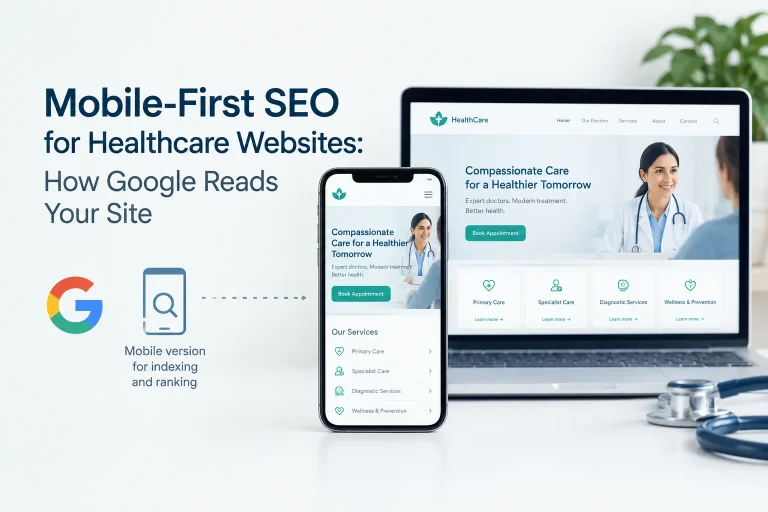
Pillar 5: Mobile-first SEO for healthcare websites
Most of the symptom-based searches are carried out on phones.
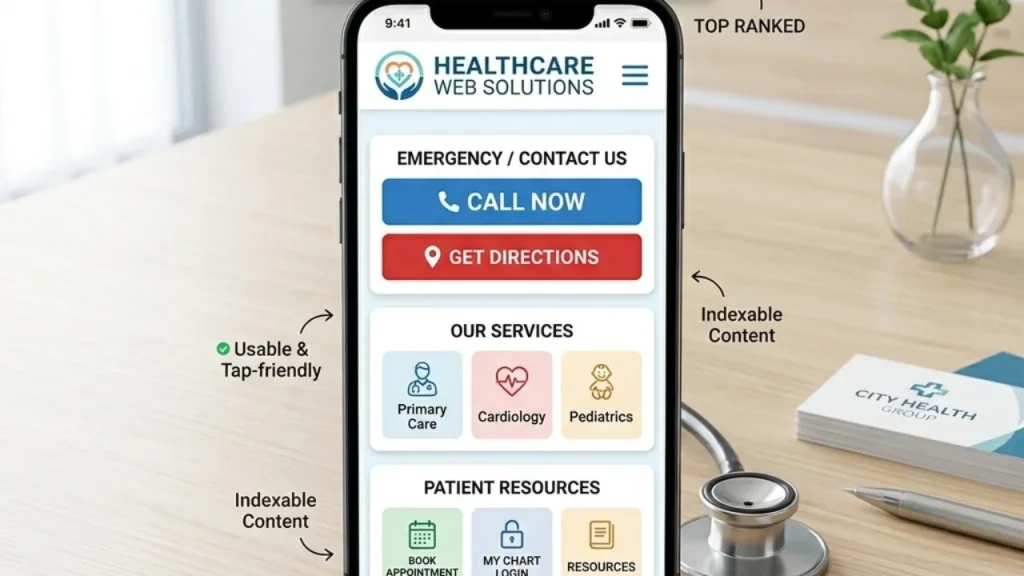
The way a website is designed influences whether a patient who is concerned remains on the site long enough to locate contact details. This involves using responsive design, providing accessible contact options such as WhatsApp buttons, and ensuring that clinical information is clear on mobile devices.
The implementation of mobile-first SEO on healthcare websites.
How technical SEO connects to other healthcare SEO layers
Technical SEO by itself is not enough; it only forms the basis of your overall strategy.
- Local SEO. The technical foundation is important for Local SEO for healthcare since in order to appear in Google’s local search results it is necessary to correctly mark up structured data concerning the location and the provider — for instance, the two outpatient departments of Dr. Islam or the two clinics of Dr. Tanvir.
- Content strategy. Content strategy uses technical SEO to ensure that articles on symptoms are accessible to readers through fast loading times and proper indexing. A patient-first approach to content is also central to why generic SEO fails for health websites.
- YMYL trust. The trust related to YMYL content is based in part on technical signals, such as a clear distinction between authors and reviewers, semantically marked disclaimers, and a stable, professional site structure.
- Provider-type SEO. Since doctors, clinics, and hospitals need provider-type SEO, it is necessary to have consistent structured data for each entity, whether this entity is a single specialist or a larger practice. When a practice runs more than one location, this becomes a system-level challenge covered in detail in multi-location healthcare SEO.
Each of the layers has its own strategy, which is set out on the corresponding dedicated pages.
Common technical SEO problems in healthcare websites
Similar problems can be found on a large number of healthcare websites.
- Missing or incomplete medical schema markup, which means that Google has to work out who the author is and what the review status is.
- Slow pages caused by large images, usually anatomical illustrations and high-resolution photos, which are not optimized for the web.
- Duplication or inconsistency between bilingual page versions, for example, between Bangla and English, without appropriate hreflang tags.
- Poor internal linking between related condition pages; for instance, the page about piles might not include a link to the page on anal fissures, thereby missing out on both clinical and SEO benefits.
- Hard-to-use mobile contact features such as WhatsApp links or call buttons that are positioned below the fold or require multiple taps, which negatively affects usability.
- Inefficient crawl structure due to the large number of symptom pages, making it difficult for search bots to prioritize.
How to get started
You needn’t deal with all the issues at the same time. Instead, follow this practical sequence.
- Conduct a preliminary technical audit to assess the site’s speed, mobile usability, indexation, and structured data before making any changes.
- Prioritize by clinical and business risk. Pages presenting urgent symptoms should be given priority over those providing general information.
- Add core medical schema. Start by incorporating the Physician and MedicalWebPage schemas onto your most important pages.
- Fix critical speed problems by dealing with the pages that have large images or video embeds.
- Check the site’s architecture and internal linking to make sure that relevant clinical topics are properly linked together via an effective site structure.
When dealing with practices that have complex structures—such as those involving more than one doctor, multiple locations, or various language versions—it is advisable to obtain expert assistance from people who are knowledgeable about the healthcare situation.
Frequently asked questions
After how long will you be able to see the results of technical SEO?
Certain improvements, for example those relating to speed, might see results in about a week or so. Gains in ranking and indexing resulting from changes to the schema and architecture generally show up within two to four months.
Can patient trust alone be solved through technical SEO?
Not completely; while technical SEO involves the use of trust signals via proper author and reviewer schema, clinical accuracy, content quality, and clear credentials still form the core of establishing patient trust.
Should the doctor or the web agency be in charge of technical SEO?
The best method is to hire a healthcare SEO specialist who is knowledgeable about Google’s technical requirements and clinical aspects, and then work with the site’s developer.
What if I am unable to carry out the entire audit at one time?
Begin with some specific improvements, for example by compressing the images, adding the basic Physician schema, and checking the mobile speed on your most frequently visited symptom pages, before making more extensive changes.
Does technical SEO have an impact on visibility in AI search results?
Certainly, it does. AI summary tools are able to accurately extract and quote your medical information because structured and clear data is available, since an increasing number of patients are using AI tools to carry out searches.
How often should you review technical SEO?
Consider technical SEO an ongoing process, and make sure to review it each time you add new pages, update your platform, or launch a new language version.
References
- Google Search Central — Core Web Vitals, page experience, and structured data for medical organizations.
- Schema.org — Physician, MedicalCondition, and MedicalWebPage type specifications.
- Google Search Quality Rater Guidelines — E-E-A-T and YMYL content standards.
- Practice examples referenced: nazrulislamcolorectal.com and tanvirorthopedics.com — cited solely to illustrate real-world technical SEO context, not as endorsements.
Conclusion
The success of a healthcare website depends essentially on clinical experience and high-quality content, but these factors on their own are not enough.
Patients are unable to find, read, or have confidence in any content which search engines are not able to crawl, interpret, or rank properly.
Technical SEO is the system that makes good content genuinely visible; for people such as Dr. Islam or Dr. Tanvir, putting effort into a technical foundation doesn’t take the place of the trust earned over years of clinical work; rather, it ensures that trust reaches the patients who need it.
The next step is clear: conduct a technical audit of your healthcare website, followed by architecture planning and prioritized improvements across the five pillars outlined above. Once that foundation is stable, you can build on it with a structured healthcare local SEO strategy that helps nearby patients find your care.
To move forward, explore our Healthcare SEO Services, where technical SEO integrates with content, local, and provider-type strategies to help the right patients find your care.
About the author
Salauddin Biswas is a healthcare website structure and content SEO specialist with an MA in Medical Anthropology from Heidelberg University, Germany. Since 2017, he has supported U.S. and global healthcare providers from Bangladesh. His work focuses on transforming clinical expertise and medical credibility into digital visibility that reaches patients.
Former Senior Research Associate, James P Grant School of Public Health, BRAC University. Co-Researcher, REACHOUT Consortium.
Last reviewed: September 22, 2026