
Healthcare Local Citations and NAP Consistency
|
Quick Answer: A healthcare local citation is any online mention of your practice’s name, address, and phone number (NAP). When that information matches everywhere, it can strengthen local trust signals and support local search visibility. When it conflicts, it confuses both search engines and patients.
|
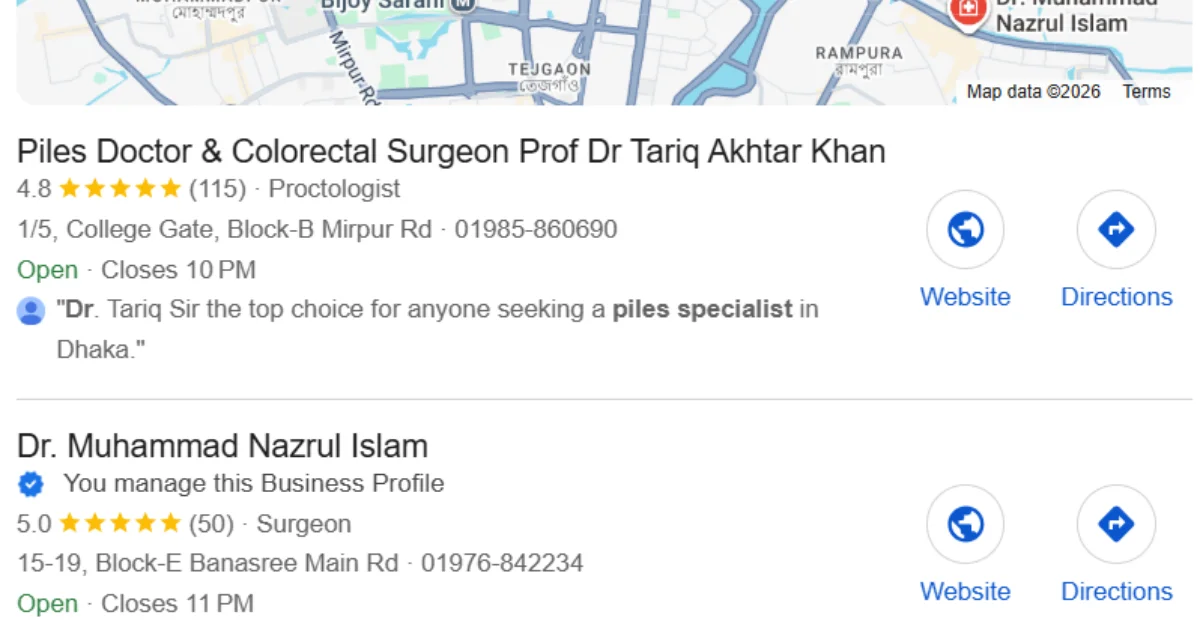
A patient searches for a colorectal surgeon nearby. Two listings appear.
One has the right address and phone number. The other has an old number and a mismatched location.
They call the second one. No one answers. They move on.
That happens every day. Not because the practice is bad — but because the information was wrong.
This article explains what healthcare local citations are, why NAP consistency is harder to maintain in healthcare, and how to audit and fix the issues that quietly hurt your local SEO and visibility.
What Is Healthcare Local Citation?
A local citation is any online mention of your practice’s name, address, and phone number.
These appear on Google Business Profile, Healthgrades, WebMD, Zocdoc, Yelp, and dozens of medical directories.
Citations work as reference points. When many authoritative sources show the same information, search engines gain confidence in your data. That confidence can improve local rankings.
Citations come in two forms:
- Structured citations: Directory listings with defined fields for name, address, phone, and URL.
- Unstructured citations: Mentions in articles, press releases, or news sites — without a set format.
Both matter. Structured citations tend to have the most direct impact on rankings. Unstructured citations support entity recognition and authority.
For healthcare providers, citations also appear on insurance directories, hospital network pages, and government health portals. That breadth is both an asset and a source of complexity.
What NAP Means — and Why It Matters
NAP stands for Name, Address, and Phone number.
These three fields are the foundation of local search identity.
When your NAP is consistent across sources, search engines can confidently link all those mentions to one entity. When it is inconsistent, that confidence drops. The result can be lower rankings, weaker map-pack visibility, and confused patients.
Consistency does not mean identical punctuation everywhere. “St.” versus “Street” is unlikely to cause problems.
What matters is meaningful consistency: the same suite number, the same practice name, the same phone line.
Even small deviations — a dropped suite number, an abbreviation used in one place and not another — can dilute citation value over time.
NAP consistency is not the only local ranking factor. It works alongside GBP signals, reviews, location pages, and inbound links. But it is foundational. Getting it wrong undermines everything built on top of it.
Why Healthcare Citations Are Harder
A local restaurant has one name, one address, one phone number.
A healthcare practice often has none of those in the singular.
Healthcare introduces complexity most other industries do not face:
- Multiple providers operating under one practice name, each sometimes listed separately
- Multiple locations for the same provider or group
- Credentialing and insurance directories that pull and publish provider data independently
- Hospital affiliations that create duplicate or competing listings
- Staff turnover that leaves outdated provider profiles active
- Medical licensing databases that list providers with formal name formatting
Each of these creates opportunities for NAP to fragment.
A listing from a credentialing database may use a provider’s full legal name and hospital address. A patient-facing directory may use a nickname and a chamber address. Neither is technically wrong — but they look inconsistent to a search engine trying to confirm your identity.
The Call Tracking Problem
Call tracking assigns unique phone numbers to different campaigns so you can measure which channels drive calls.
It is a useful tool. But it creates a NAP problem.
When a tracking number replaces your real phone number in a directory listing, aggregators pull that tracking number. Other directories copy it. Now your tracking number is scattered across the web, while your real number appears somewhere else.
Google sees two different numbers for one practice. Your NAP breaks — quietly.
The fix:
Keep your permanent phone number as the primary number on all directory listings. Use tracking numbers only in ads, landing pages, and campaign placements — not in structured citations.
Some platforms allow a secondary number field. If tracking matters to your reporting, use that field instead.
Provider vs. Practice Listings
This is one of the most common citation problems in healthcare — and one of the least discussed.
A practice has its own listing. Each provider within that practice may also have an individual listing on the same directories.
When those listings show different addresses, phone numbers, or name formats, search engines receive conflicting signals about who is who and where they are.
Here are two real-world examples that show how this plays out.
Dr. Muhammad Nazrul Islam is a colorectal and general laparoscopic surgeon based in Dhaka, Bangladesh. He holds FCPS (Surgery), MS (Colorectal Surgery), and FACS credentials, and is registered with BMDC under number A-42965.
He practices at two locations: Farazy Hospital (House No. 15-19, Block E, Main Road, Dhaka 1219) and Module G Hospital (1/G/3, Paribag, Hatirpool, Shahbagh, Dhaka 1000). His practice website is nazrulislamcolorectal.com.
The citation challenge is visible immediately. He has two physical addresses.
If one directory lists him under Farazy Hospital and another lists him under Module G Hospital — both with the same phone number but different addresses — that is a genuine NAP split. Multiply this across ten directories and you have a fragmented citation profile.
Dr. Tanvir is an orthopedic surgeon at tanvirothopedics.com. He practices at IBN Sina Malibagh and Rashmono Specialized Hospital — again, two locations, two potential address variations that can appear inconsistently across directories.
In both cases, the citation strategy needs a clear decision: which address is the primary address for each listing type, and how does the provider listing relate to any practice or hospital listing that may also exist?
Without that decision made deliberately, directories make it for you — inconsistently.
Where NAP Usually Breaks Down
Knowing the common breakpoints makes auditing faster.
- Credentialing and insurance directories: These often pull from provider databases using legal name formatting and hospital addresses — not chamber or clinic numbers.
- Data aggregators: Platforms like Foursquare, Data Axle, and Neustar push data to hundreds of downstream directories. An error here spreads widely.
- Old website contact pages: A practice that moved two years ago may still have the old address indexed and cited from legacy pages.
- Hospital profile pages: A provider listed on a hospital’s “find a doctor” page may show a hospital office number, while their independent listing shows a chamber number.
- Review platforms: Patients sometimes suggest edits to listings. Those edits may include incorrect information that gets published without verification.
- Social media profiles: Facebook, LinkedIn, and similar platforms are often missed in audits — but they are indexed by search engines and can contribute to inconsistency.
How to Audit Your Citations
A citation audit does not require expensive software. Here is a straightforward process.
Step 1: Set your canonical NAP
Before auditing anything, define what correct looks like.
Write down the exact name, address, and phone number as you want them to appear everywhere. If you have multiple locations, document a canonical NAP for each. Keep this in a reference document you can return to throughout the process.
Step 2: Search for existing citations
Search your practice name and phone number on Google, Bing, and major health directories.
Use tools like BrightLocal, Whitespark, or Moz Local to pull a broader report. Look for every place your NAP appears — not just the obvious ones.
Step 3: Record what you find
Create a simple spreadsheet.
Columns should include: directory name, URL, current name, current address, current phone, and a notes field for inconsistencies. Fill in one row per source.
Step 4: Flag the errors
Compare each row to your canonical NAP.
Flag anything that differs meaningfully — wrong suite number, outdated phone, misspelled street name, or a provider name formatted differently from your standard.
Step 5: Prioritize by authority
Not all citations carry equal weight.
Start with Google Business Profile, Healthgrades, WebMD, Zocdoc, Yelp, and major data aggregators. Fix these first. Secondary directories follow.
Step 6: Flag duplicates
Duplicate listings for the same entity need suppression or merging — not just correction. Note any you find.
How to Fix What’s Wrong
Once you know what is broken, fix it in order.
- Google Business Profile: Log in and correct fields directly. Changes to address and phone may trigger re-verification. Complete this promptly.
- Major health directories: Most have a “claim your listing” process. Once claimed, edit fields to match your canonical NAP. Some require identity verification.
- Data aggregators: Submit a data update directly to aggregators like Data Axle or Neustar. Changes will flow to downstream directories over weeks or months.
- Directories without self-service: Contact the support team with correct information and your verification details. Keep records of your requests.
- Duplicate listings: Request suppression or merging through the platform’s process. Do not just add correct information to a duplicate — get it removed or merged first.
Expect this to take time. Some directories update within days. Others take weeks.
Persistence matters more than speed here.
How Citations Fit Into Local SEO
Citations do not work alone. They are one layer of a broader local SEO structure.
Consistent NAP supports your Google Business Profile signals. Your GBP signals work alongside reviews, location pages, and structured data on your website. Each layer reinforces the others.
This article focuses on citation strategy and NAP consistency. For the full picture — including GBP optimization, location page structure, and local link building — see the related pages in our Local SEO for Healthcare cluster.
Keeping Citations Clean Over Time
A one-time audit fixes today’s problems. Staying clean requires an ongoing process.
Build these habits into your operations:
- Update immediately when anything changes — phone number, address, provider name, or suite number. Do not wait for someone to notice an error.
- Spot-check your top 10 citation sources every quarter. This takes less than an hour and catches drift early.
- Assign a single owner. Someone in the practice — or your SEO partner — should be responsible for citation accuracy. Shared responsibility often means no responsibility.
- Watch for user-suggested edits. Google and some directories let users suggest changes. These can publish without your knowledge. Turn on notifications where available.
Multiple Locations and Specialists
If your practice operates from multiple locations, each one needs its own canonical NAP and its own citation set built around that address.
Do not use one central phone number across all locations unless that number routes correctly for each site.
For specialists who practice at more than one location — like Dr. Nazrul Islam at both Farazy Hospital and Module G Hospital — the citation strategy should clearly designate a primary address for each listing type.
A practitioner-level listing may reference both locations in the description. But the core NAP field should show one consistent address per listing.
Specialist directories often ask for a primary practice location. Be deliberate about which address you enter. Keep it consistent across every platform that asks the same question.
When to Get Expert Help
For a single-location practice with a small number of listings, a careful internal process can handle most citation work.
For multi-provider groups, practices with multiple locations, or situations where citations have accumulated errors over years, a healthcare SEO specialist brings two clear advantages:
- Access to tools that surface citations you would not find manually
- Experience handling edge cases — duplicate suppression, provider versus practice separation, and credentialing database submissions
A good specialist builds citation work into a broader local SEO plan so that citations support — rather than work against — your GBP signals, reviews strategy, and on-site structure.
The goal is not just fixing what is broken. It is building a citation profile that accurately represents your practice across every platform a patient or search engine might consult.
Frequently Asked Questions
What is a healthcare local citation?
A healthcare local citation is any online mention of your provider’s or practice’s name, address, and phone number. These appear on health directories, review platforms, insurance portals, and data aggregators. Consistent citations across authoritative sources can support local search visibility.
Why does NAP consistency matter?
Search engines use NAP data to confirm the identity and location of a business. When that data conflicts across sources, it can weaken local ranking signals. For healthcare providers, inconsistent NAP can also send patients to the wrong location or phone number — a direct operational problem, not just an SEO one.
How many citations does a practice need?
There is no single correct number. Quality and consistency matter more than volume. A practice with accurate listings on 30 authoritative directories will typically outperform one with inconsistent listings on 100. Focus on the platforms your patients actually use.
What is the difference between a provider and a practice citation?
A practice citation lists the organization — the clinic or group — as the entity. A provider citation lists an individual doctor, with their name, credentials, and sometimes a different address or phone. Both types are valid, but they need to be managed separately and kept internally consistent.
How long does fixing citations take?
It depends on how many listings need correction and which directories are involved. Some update within a few days. Data aggregators can take four to eight weeks to push changes downstream. A full cleanup for a multi-location practice may take two to three months to fully reflect across the web.
Do duplicate listings hurt local rankings?
Yes. Duplicate listings can split citation signals and confuse search engines about which listing is authoritative. Duplicates should be suppressed or merged — not simply corrected alongside the original.
Is fixing my Google Business Profile enough?
Google Business Profile is the highest priority. But fixing it alone does not resolve inconsistencies across health directories, data aggregators, and other platforms. A complete citation strategy addresses all key sources.
How often should I audit my citations?
A full audit once a year is a reasonable baseline. Quarterly spot-checks of your top 10 to 15 sources help catch drift between full audits. Any time practice information changes — new phone number, new address, new provider — run a targeted audit immediately.
Your Next Step
Not sure where your citations stand?
Start simple. Type your practice name and phone number into Google. Look at what comes back. Note anything that does not match your canonical NAP.
That is the first step of your audit — and often the clearest sign of where the work needs to begin.
For a full local SEO strategy — including how citations connect to your Google Business Profile, location pages, and reviews — explore the complete Local SEO for Healthcare resource cluster.
You can Read More Article:
Healthcare SEO Services: What They Include and When You Need Them
Why Generic SEO Fails for Health Websites: A Patient-First Strategy
About the Author
Md. Salauddin Biswas is a Healthcare Website Structure and Content SEO Specialist. He helps doctors and clinics turn complex medical topics into clear, trustworthy, and well-structured content.
He holds an MA in Medical Anthropology from the University of Heidelberg, Germany, and an MA in Islamic History and Culture from the University of Dhaka, where he graduated with 1st Class, 1st Position. He is a former Senior Research Associate at the James P Grant School of Public Health, BRAC University, and a published author in peer-reviewed health research. He has worked in healthcare SEO since 2017 and is based in Dhaka, Bangladesh. He also serves as Director and Head of Content at SA WEBSOFT.
Learn more at salauddinbiswas.com/about/
Disclaimer
This article is written for informational and educational purposes. It reflects general best practices in local SEO at the time of publication. SEO recommendations may change as search engine algorithms and platform policies evolve. Nothing in this article constitutes a guarantee of specific ranking outcomes. Healthcare providers should seek qualified SEO guidance tailored to their individual practice structure, location, and specialty.
The real-world examples of Dr. Muhammad Nazrul Islam (nazrulislamcolorectal.com) and Dr. Tanvir (tanvirothopedics.com) are used solely as illustrative examples of citation structure and are not intended as audits, evaluations, or claims about those individuals or their practices.
References
- “How Google determines local ranking.” Google Business Profile Help. support.google.com/business/answer/7091
- “Local Search Ranking Factors.” Moz Local Search. moz.com/local-search-factors
- “Local Citations: What Are They and Why Do They Matter?” brightlocal.com
- “NAP Consistency and Local SEO.” whitespark.ca
- Search Engine Journal. “What Is NAP in SEO and Why Does It Matter for Local Search?” searchenginejournal.com




One Comment