Healthcare SEO Services: What They Include and When You Need Them
| Disclaimer: This content is for general information only. It is not legal, medical, or compliance advice. Healthcare marketing involves rules such as HIPAA that vary by region and situation. Always consult a qualified legal or compliance professional before making decisions about patient data, advertising, or marketing practices. SEO results vary and are never guaranteed. |
Right now, someone near you is searching for help.
One person types “why does my knee hurt when I climb stairs.” Another searches “blood in stool” late at night, too embarrassed to say it aloud. A worried daughter looks up a diagnosis her mother just received. Patients rarely search in medical terms. They type what they feel, what they fear, or what they can barely explain.
Google shows them a list of providers. They click one. They book.
If that practice is not yours, the loss runs deeper than a single appointment. You lost a patient who needed you — along with the referrals and trust they would have carried to others. And you did not lose because your care was weaker. You lost because they never found you.
That is the real cost of weak search visibility: not lost rankings, but lost patients.
Healthcare SEO services fix that visibility gap. They help your practice show up when patients search for the care you provide.
In this guide, you’ll learn what these services include, who needs them, how they differ from regular SEO, what to expect from an engagement, and how to choose the right specialist.
Quick answer: Healthcare SEO services help doctors, clinics, hospitals, and health organizations get found by patients in Google search. They cover local SEO, technical SEO, on-page SEO, off-page authority building, content strategy, and SEO audits. In healthcare, this work must also respect YMYL standards, patient trust, accuracy, and HIPAA-aware marketing practices.
What Are Healthcare SEO Services?
Healthcare SEO services help patients find your practice online. It is not one tactic. It is a system where several parts work toward one goal: more of the right patients finding you.
One thing sets this work apart. Google does not judge health sites like other sites. Because bad medical information can harm people, Google holds these pages to a higher standard — a fact its own Search Quality Rater Guidelines make explicit. Strong healthcare SEO respects those rules from day one.
The work covers four connected areas:
- Your website — so Google can read it and trust it
- Your local presence — so nearby patients find you fast
- Your content — so you answer what patients actually ask
- Your authority — so Google sees you as credible
Each part supports the others. Done right, search visibility turns into real patient calls.
Who needs these services?
Healthcare SEO fits any provider that grows through patients. The scale shifts. The need does not.
- Single-location clinics — to win local “near me” searches
- Specialty practices — to rank for the conditions they treat
- Multi-location groups — to show up in every market they serve
- Hospitals and health systems — to capture demand across many services
A solo clinic and a large hospital chase different goals. But both lose patients when they stay invisible.
In short: Healthcare SEO is a connected system across your site, local presence, content, and authority — built for any provider that depends on patients finding them.
Why Healthcare SEO Is Different From Regular SEO
Healthcare SEO carries higher stakes. A weak restaurant page leads to a mediocre dinner. A weak healthcare page can confuse a frightened patient, delay care, or damage trust at the exact moment someone decides whether to believe you.
That difference changes the whole approach. Your pages must do more than target keywords. They must help patients understand their options, prove your practice is real, and show that your information is careful and honest.
In some industries, thin pages can pull traffic for a while. Healthcare does not work that way. A medical site needs strong trust signals from the start, because Google looks for clearer proof of quality when content can affect a person’s health, safety, or money.
The YMYL standard
Health content falls under Google’s YMYL category — “Your Money or Your Life.” These are topics that can affect a person’s health, finances, safety, or quality of life.
For healthcare sites, this raises the bar. A patient may read your page before choosing a doctor, booking a test, or asking for treatment. So the page must be clear, accurate, and trustworthy.
To compete, your site should show strong E-E-A-T: experience, expertise, authoritativeness, and trust. In practice, that means:
- Content written or reviewed by qualified people
- Medical and SEO claims backed by credible sources
- Clear author and reviewer information
- Accurate service, location, and contact details
- A site that looks and behaves like a real healthcare provider
- No exaggerated promises about rankings or results
Regular SEO often skips these signals. In healthcare, they decide whether patients and search engines trust you. The full framework deserves its own deep dive — see YMYL SEO.
Compliance and accuracy
Healthcare marketing also faces rules other industries never touch. Patient privacy, HIPAA awareness, review handling, lead forms, and tracking tools all demand extra care.
Good healthcare SEO works inside those limits. It uses HIPAA-aware review and lead workflows, avoids exposing patient information, and never uses patient stories or treatment details without proper permission.
Accuracy here is more than a writing standard — it protects trust. Wrong hours, outdated services, or a broken contact path hurt both rankings and patient confidence. In the worst case, they send a real patient to the wrong place at the wrong time.
In short: Healthcare SEO answers to YMYL standards, E-E-A-T signals, and compliance rules that regular SEO ignores. The tools look familiar. The stakes are far higher.
What Healthcare SEO Services Include
These services combine several parts into one program. But before any single part works, you have to understand what your patients feel when they search. That foundation shapes everything else.
Start with patient intent
Every health search carries a feeling. A patient does not just want information — they want relief from a worry. Strong healthcare SEO reads that feeling first.
And intent is not uniform. It shifts by specialty, by condition, even by the words a patient is afraid to type. Miss that, and even flawless technical SEO falls flat. A few examples from real practice areas:
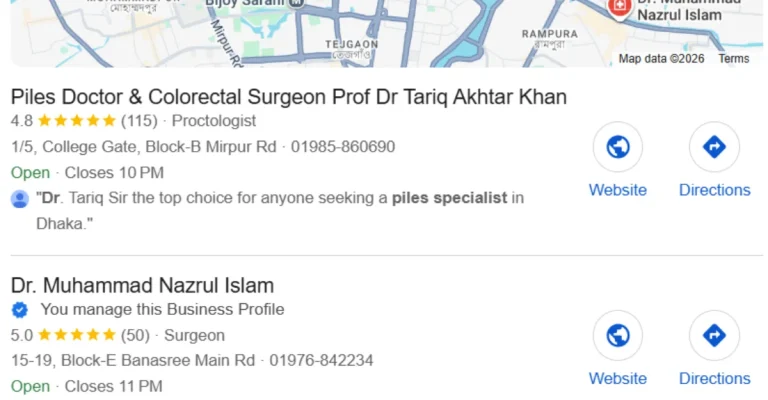
- Colorectal care — patients carry stigma and delay. They search quietly, often at night, in soft or indirect words (for example, you can visit https://nazrulislamcolorectal.com/piles-treatment-in-bangladesh/).
- Orthopedics — fear drives the search: fear of surgery, pain, and lost mobility. Patients want fast reassurance they can move again.
- Hematology — confusion and cost-fear mix. The terms are unfamiliar and frightening, so patients worry about the diagnosis and the bill at once.
When you know the real emotion, you can create true structure of the website and write content pages that remove the pain points of the patients. You match their words, ease their fear, and build trust before they ever call. That principle guides every service that follows.
Local SEO
A worried patient wants care close by, and fast. “Near me” searches drive the highest-intent traffic in healthcare, which makes local SEO your front door.
Local SEO matters for many businesses, but it carries extra weight here. Patients choose based on distance, reviews, and trust tied to their health. Your Google Business Profile, your map pack position, and your reviews all shape that choice. This work improves your profile, manages your listings, and strengthens the signals behind the map pack. See Local SEO for Healthcare for the full strategy.
Technical SEO
A patient in pain will not wait for a slow page. They leave — and that lost visitor may have needed urgent care.
Health sites carry more technical pressure than most. They hold many service pages, location pages, and provider profiles, and they need clean medical schema so Google can read them. Small errors can bury your most important pages.
Technical SEO fixes crawl issues, speeds up pages, orders your structure, and adds schema. See Technical SEO for Healthcare Websites for the details.
On-page SEO
On-page SEO sharpens the pages that capture patient demand — service pages, condition pages, and provider profiles.
It matches each page to how patients search, structures the content clearly, and builds the relevance Google needs. Thin, vague pages lose to clear, intent-matched ones every time. Each service and condition you treat deserves its own strong page. See On-Page SEO for Healthcare Websites for how to build them.
Off-page SEO
Off-page SEO builds authority from outside your site. It earns quality backlinks, grows your reputation, and raises your credibility.
In healthcare, this matters even more. Google wants proof that trusted sources stand behind you. A mention from a medical directory, a health publication, or a local hospital carries real weight; a random backlink does not. This is the trust layer Google leans on for YMYL topics — hard to fake, slow to build, and exactly why it counts. See Off-Page SEO for Healthcare Websites for the approach.
Content strategy
Content strategy ties the whole system together. It maps what patients search for, plans the pages that answer them, and builds the topical depth Google rewards. Strong content lifts rankings, earns trust, and feeds every other part of the program. See Healthcare Content Strategy for the full method.
In short: The program runs on five parts — local, technical, on-page, off-page, and content — all built on a clear read of patient intent.
SEO by Healthcare Organization Type
Your priorities shift with your type of practice. The parts stay the same; the emphasis and scale change.
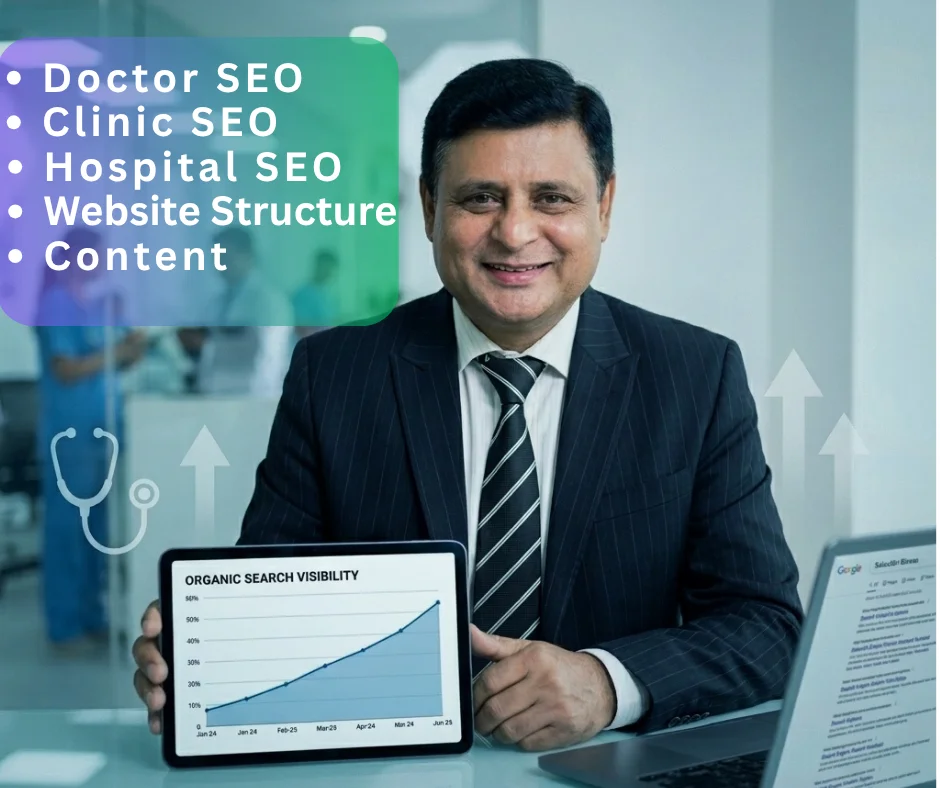
- Doctors focus on local visibility and provider authority. See Doctor SEO.
- Clinics balance local search with service-specific pages. See Clinic SEO.
- Hospitals and health systems manage many locations and specialties. See Hospital SEO.
A solo doctor and a large hospital play very different games. Pick the path that fits your scale.
When Does Your Practice Need Healthcare SEO?
You need healthcare SEO when patients cannot find you where they search. Most practices feel the pain before they see the cause.
Signs you are losing patients
Each of these patterns points to weak search visibility:
- You do not appear in the map pack for “near me” searches in your area
- Smaller competitors keep ranking above you
- Your site gets little organic traffic; most patients arrive by word of mouth
- New patient numbers have flattened or dropped, even with steady demand
- Your service pages are thin, generic, or missing
Two or more of these? Patients are choosing competitors who simply show up first. That is a visibility problem, not a care problem.
How to check where you stand
Start with a healthcare SEO audit. It shows where you rank, where your site falls short, and what holds you back — turning guesswork into a clear picture. The audit surfaces your technical issues, content gaps, listing problems, and authority gaps, so you know what to fix and in what order. Run one before you invest in anything else — see Healthcare SEO Audit to start.
What to Expect From an Engagement
A healthcare SEO engagement follows a clear path. You will not see results overnight, and anyone who promises instant rankings is misleading you. What you should expect is steady, measurable progress.
The typical phases
Most engagements move through four stages:
- Assessment — a full audit of your site, listings, content, and competitors
- Strategy — a clear plan built around your markets, services, and goals
- Execution — technical fixes, content work, local optimization, and authority building
- Measurement — ongoing tracking of rankings, traffic, calls, and inquiries
Each phase feeds the next. The work is continuous, not a one-time project, because search competition never stops.
What results to expect
Here is an honest timeline:
- First few months — early movement on local and long-tail terms
- Eight to twelve months — real growth in rankings, traffic, and patient inquiries
Timelines depend on your competition, your starting point, and your market. No honest provider guarantees exact rankings or patient numbers. What a strong program delivers is compounding visibility that turns search into a reliable patient source.
How Much Do Healthcare SEO Services Cost?
Cost depends on your scope, your market, and how many locations and services you target. A single clinic in a small market invests far less than a multi-location group competing across regions.
There is no single price because there is no single scope. For a full breakdown of what drives cost and how to budget, see Healthcare SEO Pricing.
How to Choose a Healthcare SEO Specialist
Not every SEO provider is built for healthcare. A generic agency may understand keywords but miss the trust, compliance, and patient-language demands that decide success here.
Look for someone who understands:
- How patients actually search — in symptoms, fears, and plain words, not clinical terms
- YMYL standards and E-E-A-T signals
- Local and technical SEO for multi-page, multi-location health sites
- Patient privacy and HIPAA-aware workflows
- Content accuracy, honest claims, and careful sourcing
Why patient-language insight changes the work
Here is one distinction worth weighing when you choose. A generic writer starts with a keyword list. Better healthcare SEO starts with the patient journey behind that list.
The phrase “knee pain doctor” is not just a search term — behind it may sit fear of surgery or worry about missing work. “Blood in stool” is not just a topic — behind it may sit embarrassment, silence, and dread of a serious diagnosis.
When your specialist reads that layer, the pages change. They use the words patients use, answer the questions patients are afraid to ask, and guide someone from symptom to service to appointment without feeling cold or salesy.
My own background in medical anthropology sharpened this lens: years of fieldwork and research into how people describe illness, delay care, and let culture, stigma, and fear shape their decisions. That is the difference between building pages around guesswork and building them around real patient behavior, clinical reality, and trust.
In short: Choose a specialist who reads patient intent, respects YMYL and compliance limits, and turns clinical expertise into a search experience patients can trust.
Frequently Asked Questions
What do healthcare SEO services include?
They combine five connected parts: local SEO, technical SEO, on-page SEO, off-page authority building, and content strategy — all built on a clear read of patient intent. Local SEO captures nearby searches, technical SEO makes your site readable, on-page SEO sharpens your service and condition pages, off-page SEO builds authority, and content strategy ties it together. The exact mix depends on your size, markets, and goals.
How is healthcare SEO different from regular SEO?
Healthcare SEO works under Google’s YMYL standard, which holds medical content to a higher bar for accuracy and trust. Your site must show strong E-E-A-T before Google rewards it, and the work stays inside HIPAA-aware limits that regular SEO ignores. The tools look similar. The stakes and standards are far higher.
How long does healthcare SEO take to work?
Most practices see early movement on local and long-tail terms within the first few months. Real growth in rankings and patient inquiries usually takes eight to twelve months, especially in competitive markets. Your timeline depends on your starting point and competition. This is a long-term investment that compounds, not a quick fix.
How much do healthcare SEO services cost?
Cost depends on your scope, market, and number of locations and services. A single-location practice invests far less than a hospital system, and pricing models vary by provider. Because there is no single scope, there is no single price. For a full breakdown of what drives cost, see Healthcare SEO Pricing.
Do small practices need SEO, or just large hospitals?
Small practices often need it as much as large hospitals. A solo clinic leans heavily on local patients, and local search is exactly where those patients decide. Without visibility, a small practice loses them to competitors who simply show up first. The scope is smaller. The need is just as real.
How do I choose a healthcare SEO specialist?
Look for someone who understands patient search behavior, YMYL standards, local and technical SEO, patient privacy, and content accuracy. A generic provider may know keywords but miss the trust and compliance demands that decide healthcare results. The “How to Choose a Healthcare SEO Specialist” section above walks through what to check.
Is healthcare SEO different for doctors, clinics, and hospitals?
Yes. Doctors usually need stronger provider authority and local visibility. Clinics need service and location pages that match patient demand. Hospitals and health systems need SEO that scales across many departments, specialties, and locations. See Doctor SEO, Clinic SEO, and Hospital SEO for the path that fits your scale.
Start With a Clear Picture of Where You Stand
Patients are searching for your care right now. The only question is whether they find you or a competitor.
Healthcare SEO services close that gap. They connect patient intent, local SEO, technical SEO, on-page SEO, content strategy, and authority into one system that turns search into a steady source of new patients.
The best first step is simple: a clear look at where you stand today and where your biggest opportunity sits. Book a consultation, and I’ll show you exactly where you’re losing patients and how to start winning them back.
References
- Google Search Central — Creating helpful, reliable, people-first content
- Google Search Central — SEO Starter Guide
- Google Search Central — Understanding E-E-A-T and how it affects Search results
- Google Search Quality Evaluator Guidelines (official PDF) — YMYL and E-E-A-T standards
- U.S. Department of Health & Human Services — HIPAA for Professionals
|
Written By:
Md. Salauddin Biswas is a Healthcare Website Structure & Content SEO Specialist with a deep background in medical anthropology. An alumnus of both Heidelberg University and the University of Dhaka, he specializes in medical content writing, healthcare SEO, and building patient-first content strategies. Currently, he works for SA WEBSOFT, helping healthcare platforms create trusted, highly optimized digital structures. Connect with him on LinkedIn, Facebook, or X, or visit his website at salauddinbiswas.com.
|