Multi-Location Healthcare SEO: Run Every Clinic as One
Quick Answer
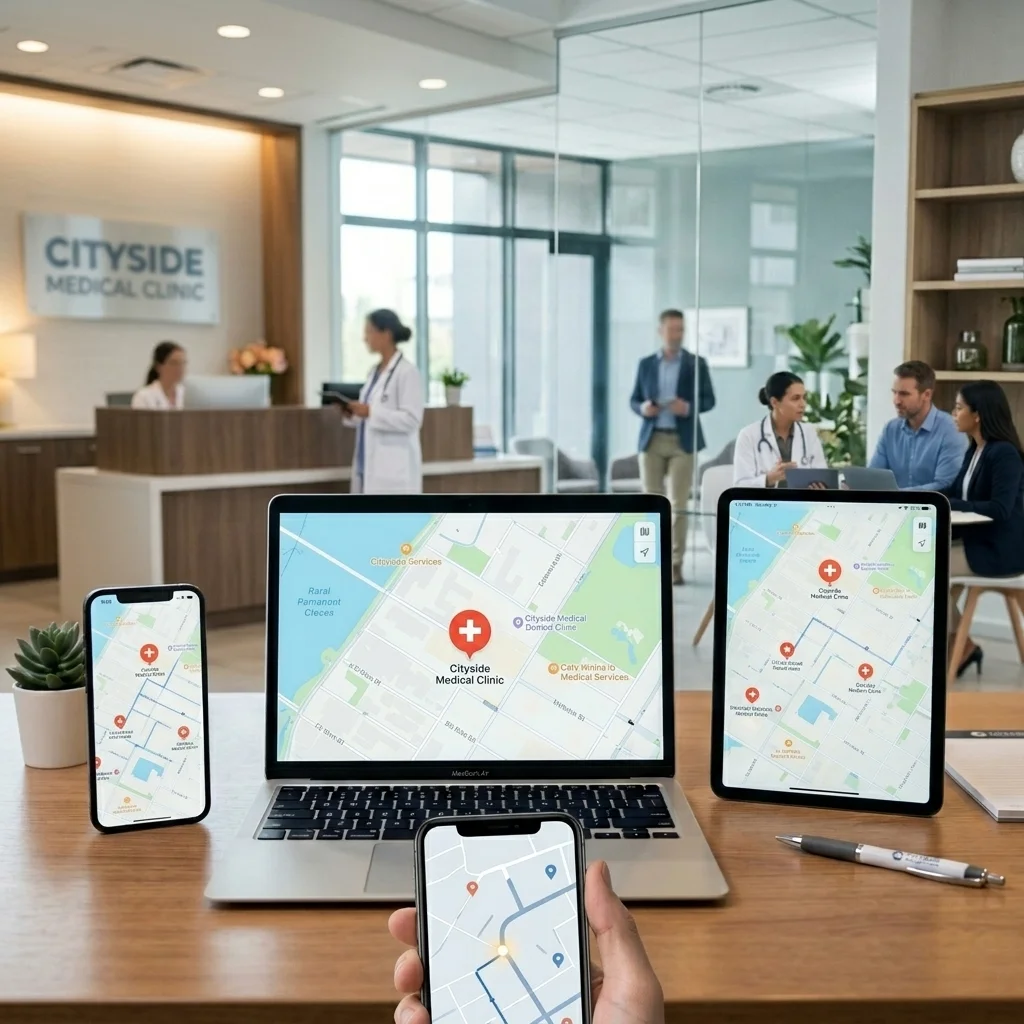
Multi-location healthcare SEO is the process of managing local search across multiple clinics, hospitals, campuses, chambers, or offices as a single coordinated system.
This matters because local SEO fails when each location operates independently. Pages compete, profiles become inconsistent, NAP details no longer match, and provider information lacks a clear structure.
The core rule is straightforward: maintain one brand standard, create a distinct page and profile for each real location, ensure consistent NAP, establish clear provider-location links, and avoid duplicate content. Centralized consistency provides protection, while local distinctness improves search performance.
DisclaimerThis content is for general information only. It is not legal, medical, or compliance advice. HIPAA rules can be complex and depend on your specific situation. For privacy and compliance decisions, consult a qualified healthcare compliance professional or attorney. Google’s features and policies may change after publication; always check the official sources.
|
As a healthcare practice expands beyond a single clinic, campus, or office, local SEO shifts from a simple task to a system that requires active management.
Managing this system is more complex in healthcare than in retail. Unlike stores, clinics often have rotating staff and specialists across multiple campuses. Patients searching for care need accurate information—location, hours, and contact details—immediately. If coordination fails, patients notice only the incorrect information, not your efforts.
This page is part of a broader strategy. It addresses the Local SEO layer for Healthcare, ensuring multiple locations operate cohesively. It focuses on system-wide coordination rather than individual clinic optimization.
What Multi-Location Healthcare SEO Really Means
Single-location SEO is a task. Multi-location SEO requires governance—a set of rules that align all components toward a common goal.
Consider a network in which each location operates independently yet follows a unified strategy. Without central coordination, locations may overlap efforts, compete for the same audience, and lose effectiveness.
Your locations function best when unified under your brand and SEO system. Coordinated management ensures that locations support one another, while a lack of coordination leads to internal competition and inefficiency.
This page does not cover individual location optimization; that guidance is available in our Location Pages for Healthcare Websites guide. Here, we focus on managing the entire network.
Are your locations operating in alignment, or are they disconnected?
Why Scale Breaks Single-Location Tactics
A strategy designed for a single clinic cannot effectively manage multiple locations. As the number of locations increases, signals can conflict, and challenges multiply.
Four things break first:
- Self-cannibalization occurs when two location pages target the same keyword, thereby dividing their ranking power and as a result both suffer a decline.
- The signal gets diluted because your authority is spread out over a large number of poor-quality pages rather than being built up behind a few strong ones.
- Confusion about entities. Google is unable to determine which clinic is which. The brands are the same, the pages are similar, and the providers are intermingled. The map then collapses.
- Patients’ journeys are fragmented. When a patient reaches the wrong page for a location, the wrong city and the wrong hours are displayed and then they leave.
These issues may be minor with two locations but grow significantly as you expand. Managing more locations is not simply more work; it is a fundamentally different challenge.
The System You Coordinate, Not Rebuild
Multi-location SEO does not replace your existing local SEO efforts; it coordinates them. Your role is to ensure all components work together effectively.
There are four key components to coordinate. The detailed work for each is handled separately; your responsibility here is to ensure alignment.
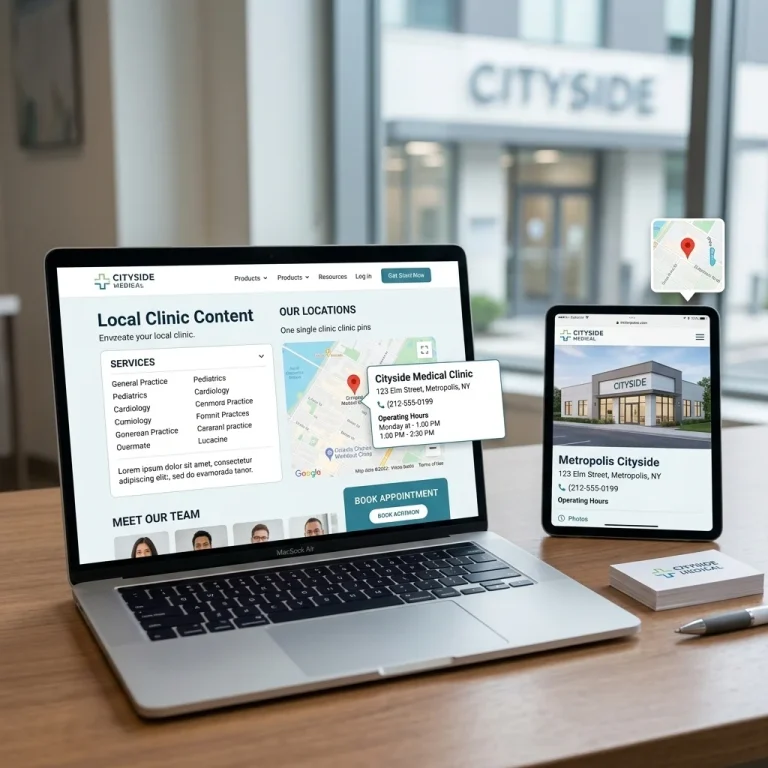
- Location pages. One distinct page per clinic. The full build is owned by Location Pages for Healthcare Websites. Here, we only make sure each page matches its profile.
- Google Business Profiles. One profile per location. The deep work is owned by Google Business Profile for Healthcare Providers. Here, we only make sure each profile points to its matching page.
- Citations and NAP. Consistent name, address, and phone for every location. The cleanup is owned by Healthcare Local Citations and NAP Consistency. Here, we only confirm that nothing drifts out of sync.
- Reviews. Patient reviews flow to the right location, under one shared policy.
Your responsibility is to coordinate these elements and prevent conflicts between them.
Is there someone actively coordinating your locations?
Centralized Control vs. Local Autonomy
A key decision in multi-location SEO is determining which elements are managed centrally and which are managed by individual locations.
If managed incorrectly, clinics may appear identical, with duplicate content, or, conversely, operate independently, with inconsistent standards and disorganization.
The solution requires a balance of both approaches.
Keep these central:
- Brand name and how it appears everywhere
- NAP format and structure
- Schema patterns and templates
- Review response policy
- Reporting cadence and measurement
- Content quality standards
Let each location own these:
- Its own page content, in its own words
- It’s real hours, including holidays.
- Its specific services and providers
- Its neighborhood signals and local context
- Its own reviews and local reputation
Centralized management ensures consistency, while local control provides relevance. A regional group with multiple offices remains one brand with several unique locations.
Which decisions are managed centrally, and which are left unaddressed?
Keeping Locations Distinct Without Duplicate Content
Duplicate content is a significant but often unnoticed issue for multi-location sites.
This occurs when a successful page for one location is copied for another, with only minor changes such as the city name and address. Google may then view these as duplicate pages, selecting one and disregarding the others, which negatively impacts all locations.
Each clinic is a real, different place. Write each page to match that reality:
- Describe the actual neighborhood, not a template.
- List the real services at that address, not the full network menu.
- Name the providers who actually work there.
- Use the real local landmarks and context.
A template can provide structure, but each location page must be written from scratch to reflect its unique characteristics. Establish this rule and apply it to every new clinic.
Do your location pages provide unique information, or are they simply variations of the same content?
Managing Provider-Location Relationships at Scale
This complexity makes healthcare more challenging than retail, which is why generic, multi-location advice is often insufficient.
Providers often work at multiple locations, with schedules that vary across campuses and offices. As your network grows, managing these relationships becomes increasingly complex.
Approach this as a system rather than a simple list. Two clear rules maintain order:
- One identity per provider. Each doctor has one home — one profile, one set of credentials, one clear entity.
- One page per place. Each clinic has one location page that lists the providers who practice there.
Next, establish links between providers and locations. Each provider’s profile should reference every location where they practice, and each location page should list the providers who work there. This ensures clear, bidirectional connections.
The specifics of building each page and profile are addressed in the Location Pages for Healthcare Websites and Doctor SEO guides. At the system level, your responsibility is to maintain clear and organized provider-location relationships as your network expands.
Does each provider in your network have a single, clear identity, or are their profiles inconsistent?
Reputation and Reviews Across Many Locations
Reviews influence local rankings and, at scale, present management challenges. Patients focus on reviews for the specific location they plan to visit, not the overall network. Each location requires a steady flow of reviews and a consistent management process.
Set one governance-level policy, not ten separate approaches:
- Route reviews to the right location. Each patient reviews the clinic they visited on that location’s profile.
- Respond with one voice. Same tone, same care, same speed everywhere.
- Monitor reviews for each location individually, as a single underperforming location can negatively affect the entire brand.
One point deserves special care: public review replies in healthcare carry real compliance weight. A careless response can expose protected health information. Because that risk touches trust and legal exposure, the full framing is owned by YMYL SEO.
Here, hold one rule — never confirm a patient relationship, a diagnosis, or any health detail in a public reply.
Are your reviews managed through a structured system, or handled inconsistently?
Site Architecture for Many Locations
Your website structure determines how authority is distributed. This is a governance decision, and for most healthcare brands, the preferred approach is clear.
Disclaimer
This content is for general information only. It is not legal, medical, or compliance advice. HIPAA rules can be complex and depend on your specific situation. For privacy and compliance decisions, consult a qualified healthcare compliance professional or attorney. Google’s features and policies may change after publication; always check the official sources.
A structure like yourbrand.com/locations/austin keeps every location on one domain, so all your authority stacks behind a single strong site. It is easier to govern, and it concentrates your strength.
Alternative structures, such as subdomains or separate domains, typically divide your authority and are less effective for a single healthcare brand. Use these options only if a location must operate independently.
Once you have chosen your structure, implement the following elements:
- A location’s hub — one page that links to every location page
- Regional grouping if your network is large enough to need it
- Clean internal links between related pages
Maintain a single domain with a central hub and multiple distinct location pages. The technical details are addressed in the location-page guide; your focus here is on selecting the appropriate architecture.
Does your site structure consolidate your authority, or does it disperse it?
Common Mistakes That Sink Multi-Location SEO
Even well-managed networks can encounter these common issues, which are often overlooked.
- One shared Google Business Profile. Several clinics crammed into one profile. Google can’t place any of them.
- Duplicate location pages. Copy-paste content with the city swapped. Your pages cancel each other out.
- Inconsistent NAP. A different phone format here, an abbreviated address there. Each mismatch chips away at trust.
- Fragmented patient journeys. Profiles point to the homepage instead of the matching location page. The patient lands lost.
- Orphaned locations. A location page with no internal link reaches. Invisible to patients and Google alike.
- No central governance. Every location does its own thing. Slow drift into chaos.
- Stale legacy listings. Old addresses and dead numbers from closed or moved offices are still living in directories.
Any of these issues can negatively impact your rankings. Many struggling networks experience several of them simultaneously.
Are any of these issues present in your network?
How to Build Your Multi-Location System, Step by Step
Complete these steps in sequence. Each serves as a coordination checkpoint to confirm, rather than a detailed tutorial. Specific implementation guidance is provided in dedicated resources.
- Inventory every location. List every physical place you staff in person. Real addresses only. No virtual offices. This is your fleet.
- Decide on your architecture. Choose subfolders for most healthcare brands, and stand up a locations hub that links to every clinic.
- Set central standards. Lock your NAP format, schema patterns, content rules, and review policy in writing. These apply everywhere.
- Confirm profile-to-page alignment. Verify that each Google Business Profile exists once per location and points to its own matching page.
- Verify citation consistency. Confirm every location’s NAP matches across directories, and that stale listings are cleared.
- Check page distinctness. Verify that no two location pages share content, and that each reflects a real neighborhood, services, and providers.
- Coordinate the review system. Confirm reviews route per location, and responses follow one voice and one compliance rule.
- Measure per location. Track rankings, calls, and conversions for each clinic — not just the network total. Find the weak links. Fix them.
Apply these steps across your entire network initially, and then implement the standards each time a new location is added.
Can you document your entire network this week?
Internal Linking and Hierarchy at Scale
Internal links communicate your network’s structure to Google. Design them intentionally.
This page sits above its sub-pages and coordinates them. The linking should show that:
- Down to your locations hub, and from there to every location page
- Across to your supporting guides — Google Business Profile for Healthcare Providers, Healthcare Local Citations, and NAP Consistency
- Between providers and locations, so each relationship is clear.
- Up to the parent, Local SEO for Healthcare, which holds the whole cluster
A network without internal links lacks clear communication between pages. Effective internal linking helps patients find the correct location quickly and demonstrates your site’s hierarchy to Google.
Do your internal links present Google with a clear, organized network or a collection of disconnected pages?
How a Healthcare SEO Expert Manages Multi-Location SEO
With discipline and a clear system, you can manage much of this yourself. However, coordinating multiple locations is challenging, as pages, profiles, citations, and provider relationships can become misaligned over time. This is where expert guidance is most valuable.
What the expert does:
- Maps your full network and chooses the right architecture
- Sets central standards for NAP, schema, content, and reviews
- Keeps each location page distinct and free of duplication
- Coordinates profiles, citations, and pages so none compete.
- Untangles provider-location relationships across the network
- Builds a per-location review system that stays compliance-aware
- Measures each location separately and fixes the weak ones.
What you supply — a simple checklist:
- Every real location you staff in person
- Exact NAP for each location
- Real hours, including holidays, per location
- Services and providers at each address
- Provider credentials and how they rotate across sites
- Access to your website, profiles, and content system
Why choose Salauddin Biswas: He delivers specialized healthcare SEO, not generic agency solutions. His background in Medical Anthropology informs his understanding of patient behavior, urgency, and search patterns. He applies this insight at the system level, ensuring your network operates cohesively while preserving each location’s unique qualities.
You can check his recent work by clicking here.
A candid note: No one can guarantee specific rankings or patient volumes for your locations. Outcomes depend on your market, competition, consistency, and the quality of system governance. Effective management reduces inconsistencies and gives each location the best opportunity for success.
Are you ready to unify your entire network under a single strategy?
Quick Recap Checklist
Before you call your multi-location system done, check these:
✅ Every real location inventoried, no virtual offices
✅ Subfolder architecture with a clear location hub
✅ Central standards set for NAP, schema, content, reviews
✅ One Google Business Profile per location
✅ Consistent NAP across every directory, stale listings cleared
✅ Distinct, from-scratch content on every location page
✅ One identity per provider, linked to every location they serve
✅ Per-location review routing with one response voice
✅ Compliance-aware handling on every public reply
✅ Measurement tracked per location, not just network-wide
Frequently Asked Questions
What is multi-location healthcare SEO?
It is the practice of managing local search across multiple clinics, campuses, or offices as a single coordinated system. Each location keeps its own page, profile, and consistent NAP, while central standards keep the network aligned.
How is it different from single-location local SEO?
Single-location SEO tunes one set of signals. Multi-location SEO governs many at once and keeps them from competing. The problem is not bigger — it is different.
Should each location have its own Google Business Profile?
Yes. Every staffed location needs its own profile, each pointing to its matching location page. One shared profile for several clinics hides your locations from local search.
Do I need a separate page for each location?
Yes. One distinct page per real place, written around its neighborhood, hours, services, and providers. Never copy one page and swap the city name.
What should I centralize, and what should each location control?
Centralize brand, NAP format, schema patterns, review policy, and reporting. Let each location own its content, hours, services, providers, and neighborhood signals.
How do providers who work across locations fit the system?
Give each provider one identity and one profile, then link that identity to every location where they practice. One provider, many locations, clear links both ways.
Do I need an expert, or can I manage this myself?
You can govern much of this yourself with a clear system. An expert helps most with architecture choices, untangling provider-location relationships, and keeping many pages distinct as the network grows.
Your Next Step
A coordinated network consistently outperforms disconnected clinics. Managing your locations as a unified system ensures your pages, profiles, citations, and reviews work together effectively.
Begin by inventorying your locations this week. Choose your site architecture and establish three central standards that apply to every clinic. Create a unified, actionable plan.
When you’re ready to connect this to your full local strategy, explore our Local SEO for Healthcare cluster, our Location Pages for Healthcare Websites guide, our Google Business Profile for Healthcare Providers guide, and our Healthcare Local Citations and NAP Consistency guide. To pull the whole system together, finish with our Healthcare Local SEO Strategy and Checklist. Please visit our insight page.
Will you document your network this week?
About the Author
Salauddin Biswas is a healthcare SEO specialist who helps doctors, clinics, and hospitals get found by the right patients. With training in Medical Anthropology, he focuses on how patients truly search — and builds systems that stay human, clear, and trustworthy at any scale. His work follows Google’s guidelines, E-E-A-T standards, and HIPAA-aware care.
Editorial Note
This article was written to help multi-location healthcare organizations coordinate local SEO across many clinics, campuses, and offices. It is reviewed against current Google Business Profile guidance and HHS HIPAA resources. We update it as Google’s features and rules change.
References
- Tips to improve your local ranking on Google — Google Business Profile Help: https://support.google.com/business/answer/7091
- Guidelines for representing your business on Google (including multiple locations) — Google Business Profile Help: https://support.google.com/business/answer/3038177
- The HIPAA Privacy Rule — U.S. Department of Health & Human Services: https://www.hhs.gov/hipaa/for-professionals/privacy/index.html